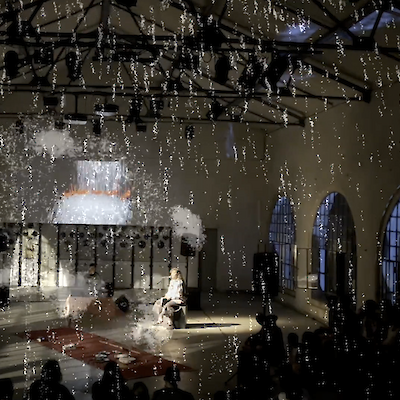
In Yesterday's Forecasts
(excerpt)
When the Silphium plant was discovered in ancient Cyrenaica (East Libya) after heavy rains and floods that hit the Mediterranean, it became a pillar of the economy and expansion of The Greek and Roman colonies until it was overharvested, heavily exploited, and documented as the first extinction of a species in our natural history. Centuries later, the Silphium returned as a symbol of the fascist reign on the Italian coat of arms when they colonized Libya in 1911, followed by establishing more than seventeen concentration camps where a third of Cyrenaica’s population was exterminated; yet, their poetry survives, and so does the memory of the Silphium.
The performance “In Yesterday’s Forecasts” explores connections between the first documented extinction and the mass-extermination of the Libyan people during the Libyan genocide (1928-1942). The lost Silphium plant and Fascism hidden histories become intertwined in a composition of recitations, soundscapes, visual worlds of the archival and the imaginary, testimonial poems and oralities based on Tamazight and Bedouin poetry. In sonic dialogue with the ancient tradition of millstone grinding known across North Africa as Al Raha.
Poems in the performance:
Twice ruined our homeland by Fatma Uthman 1928
I have no illness by Alagila camo by Rajab Buhwaish 1932
There will come a day, Said Sifaw, 1946-1994
The work build upon the scholarly work of Ali Abdullatif Ahmeida in documenting the poetry from the survivors of the Libyan concentration camps and oral evidences about the Libyan genocide.
Credits:
Concept, research and development: Tewa Barnosa
Performers: Tewa Barnosa and ghenwa (noiré) abou fayad
Live sound and music composition: ghenwa (noiré) abou fayad
Performance visuals: Dina Jeridini
Light tech: Consuelo Donati and Tewa Barnosa
Scenography: Tewa Barnosa
Sound technician: Luca
Translation to Italian: Eduardo Popescu
Advisor: Rana Hamadeh
Co-produced by Centrale Fies IT
Supported by Amarte Fonds NL
Travel support by Ettijahat Independent cultures